Professional Corporate Business Flyer
A Designer’s First Glance: Clean, Confident—but Not Built for Thread
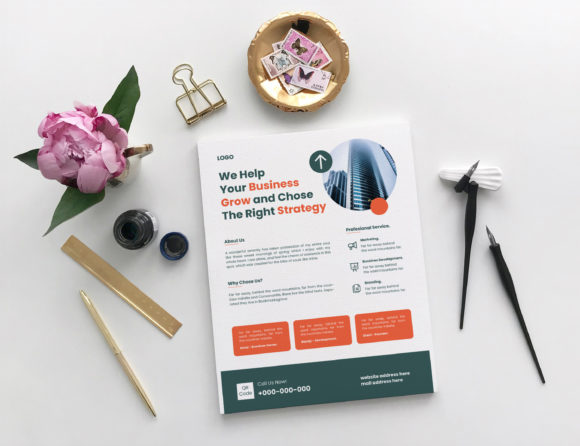
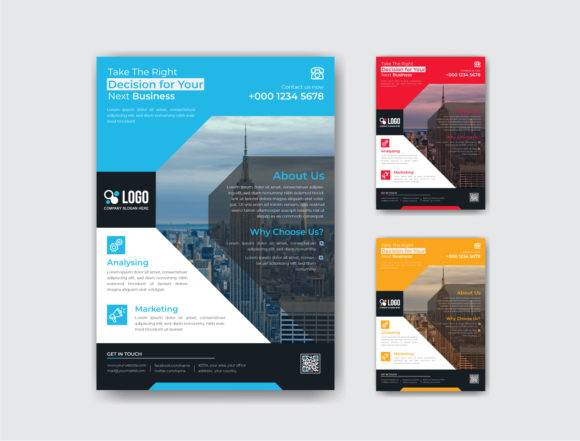
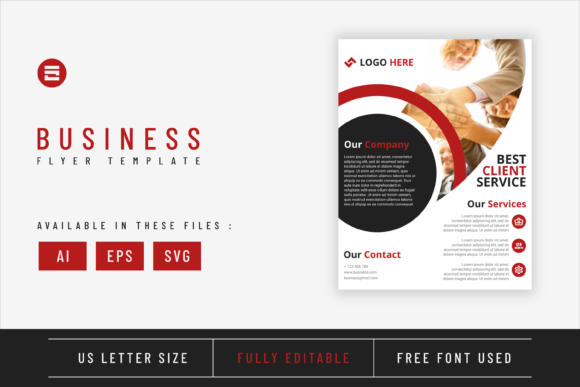
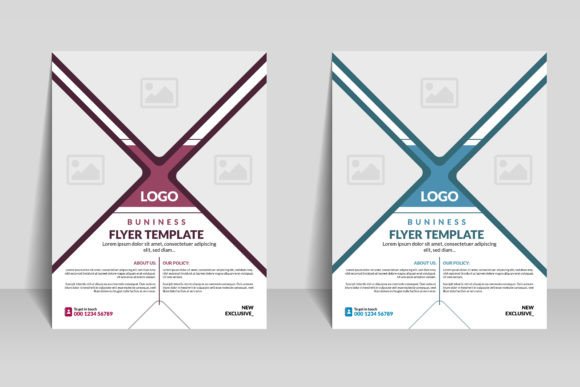
When I opened Professional Corporate Business Flyer, my first thought wasn’t “Let’s stitch this!”—it was “This belongs on a conference table, not a sweatshirt.” It’s a crisp, modern layout built for print: balanced typography, generous white space, subtle gradients, and sharp vector-based icons. The mood is polished, trustworthy, and quietly authoritative—ideal for a webinar agency or boutique consulting firm. But as an embroidery designer who’s stitched everything from baby onesies to boutique aprons, I immediately saw the disconnect: Professional Corporate Business Flyer is a graphics asset—not a machine embroidery design. It’s a Print Templates piece through and through. That doesn’t make it useless for makers—it just means you need to pause, assess, and adapt before committing thread and time.
Where It Fits—and Where It Doesn’t—in Real Embroidery Projects
I recently used a simplified version of Professional Corporate Business Flyer as inspiration for a custom embroidered tote bag for a local marketing studio. We kept only the clean sans-serif logo lockup and one minimalist icon, then redrew it as a low-density satin-stitch monogram with open negative space. Why? Because the original flyer’s dense text blocks, fine lines, and multi-layered graphic elements simply won’t translate cleanly to thread. On a sweatshirt, the small body copy would vanish into pile; on a tea towel, the thin dividers would blur under wash-and-wear stress; on a baby cap, the tight spacing between letters would cause puckering or skipped stitches.
That said, Professional Corporate Business Flyer shines as a *starting point* for craft business owners and Etsy sellers who create branded merchandise. You can lift its color palette for thread selection (navy + warm gray + cream reads beautifully on natural canvas), borrow its hierarchy to structure a simple embroidered tagline (“Launch Your Vision” instead of full paragraphs), or extract its icon set to convert into clean, scalable applique designs. For holiday embroidery or personalized gifts, think: a single refined icon stitched onto a linen pillow cover, or its logotype resized and re-digitized for a boutique apron pocket—not the full two-panel brochure.
Fabric & Function: What Makes This Design Tricky on Thread
Embroidery isn’t printing. Fabric moves. Thread builds texture. Stabilizer changes drape. So while Professional Corporate Business Flyer looks flawless at 300 dpi on screen, its real-world behavior depends entirely on how you reinterpret it:
- Small hoop sizes? Avoid any section with tight text clusters or overlapping shapes—those demand precision stitching most home machines can’t deliver consistently.
- Textured or stretchy fabric? Skip the fine-line borders and delicate serif accents—they’ll distort or disappear on terry cloth, knits, or quilting cotton.
- Dark fabric or layered garments? Its light-on-dark contrast works on paper, but thread sheen and fabric absorption change everything. Always test in black and white mockups first—and better yet, stitch a physical sample.
- Curved surfaces like caps? The horizontal layout and centered alignment don’t wrap well. Reposition key elements vertically, simplify line weight, and reduce overall width by at least 30%.
What This Design Adds to Your Handmade Product—And What It Requires
Used thoughtfully, Professional Corporate Business Flyer elevates professionalism without sacrificing warmth. When distilled into a clean embroidered patch or minimalist tote bag design, it signals competence—especially for service-based small shop products or corporate gifting. Customers notice clarity. They trust restraint. A well-executed, simplified version says “I value your attention,” not “I filled every inch.”
But that value comes with responsibility. Unlike ready-to-stitch embroidery files, Professional Corporate Business Flyer asks you to make judgment calls: Which elements survive stitch translation? How much negative space does your stabilizer allow? Does your chosen thread color pop—or mute—against the fabric’s undertone? It strengthens brand consistency only if you maintain its visual DNA (clean lines, intentional spacing, cohesive tone) across your finished product line—not by copying it pixel-for-pixel.
Practical Notes Every Embroidery Designer Should Check
Before using Professional Corporate Business Flyer in any embroidery project—personal or commercial—do these six things:
- Test the redrawn or adapted version on scrap fabric *with your exact stabilizer and thread*. Not just once—twice, with different tension settings.
- Review stitch density manually. Fill-stitch areas over 12,000 stitches per square inch often pucker on apparel. Running-stitch outlines should be no finer than 0.8mm.
- Confirm hoop size compatibility. If your largest hoop is 4×4”, trim and re-compose the core motif—not the entire layout.
- Inspect tiny lettering and decorative accents at 200% zoom. If you can’t clearly distinguish strokes on screen, they’ll vanish under thread.
- Compare mockups on both light and dark backgrounds. What reads as elegant on white may look muddy on charcoal twill.
- Verify licensing. Since Professional Corporate Business Flyer is sold as a Graphics template, confirm whether derivative embroidered products or digital embroidery files are permitted for resale—especially for Etsy sellers and craft fair vendors.
Final Thought: A Tool, Not a Template
Professional Corporate Business Flyer won’t drop into your embroidery software and stitch flawlessly. But in the hands of a thoughtful designer or craft business owner, it’s a quietly powerful tool—a source of structure, tone, and visual discipline. Use it to inspire confident simplicity, not replicate complexity. Let it guide your choices in thread color, layout rhythm, and brand voice—then let your needle do the rest. Because the best embroidery doesn’t shout. It resonates. And sometimes, resonance starts with a single, well-placed line—lifted from a flyer, reimagined for thread, and made unmistakably yours.